
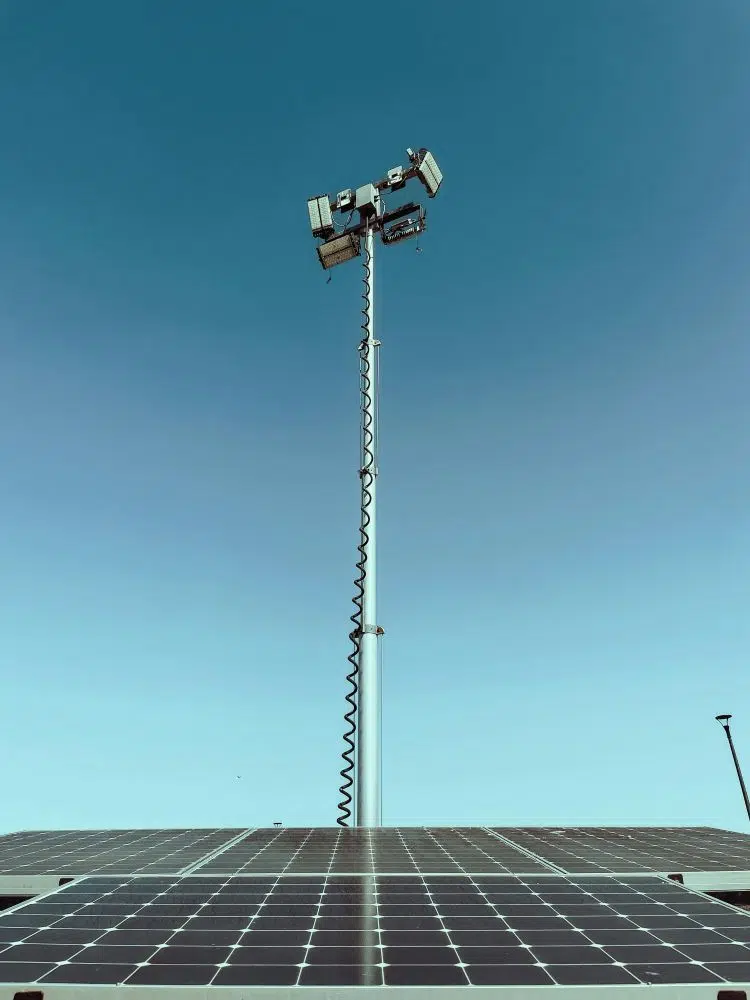
In an era where sustainability and operational efficiency are paramount across numerous industries, the demand for innovative off-grid power solutions has never been higher. Among the most significant advancements in portable illumination is the solar lighting tower.
This guide provides a comprehensive overview of what these units are, their core components, and the technology that enables them to deliver high-performance light without the need for diesel fuel.
Defining the Modern Solar Lighting Tower
At its core, a lighting tower is a mobile, self-contained illumination system designed to light up large areas where grid power is unavailable or impractical to connect. Traditionally powered by diesel generators, these units are essential for construction sites, roadworks, mining operations, emergency response scenarios, and large outdoor events.
The solar variant replaces the diesel generator with a sophisticated, integrated system of photovoltaic (solar) panels, deep-cycle batteries, and energy-efficient LED lamps. It performs the same function as its conventional counterpart by providing bright, reliable light over hundreds or thousands of square feet, but does so silently, without emitting harmful exhaust fumes, and with zero ongoing fuel costs. The result can be a powerful, eco-friendly tool that helps companies meet sustainability goals while improving bottom lines.
However, for those wanting to learn more about a lighting tower and how it works, checking out reliable resources online and consulting with professionals would be a great start.
Core Components and How They Work Together
Understanding how a solar lighting tower works requires a look at its key components and their synergy. Each part is engineered for durability and efficiency in demanding environments. Some core components include:
The Photovoltaic (Solar) Panel Array
The energy-generation heart of the system is the solar panel array. High-efficiency panels, often made of monocrystalline or polycrystalline silicon, are mounted on the unit. For example, some modern towers utilize a substantial power rating, such as 1440 watts, from multiple panels. These panels can capture sunlight during the day and convert it into direct current (DC) electricity. Their size and efficiency are critical, as they must generate enough power not only for the upcoming night’s operation but also to replenish the batteries after periods of use and account for days with less sunlight.
2. The Battery Bank (Energy Storage)
Since the sun doesn’t shine at night, energy storage is essential. The DC electricity generated by the solar panels is fed to a robust battery bank. These aren’t standard car batteries. They’re typically deep-cycle, sealed Absorbent Glass Mat (AGM) or Lithium-ion batteries designed to be discharged and recharged repeatedly. The total storage capacity, measured in amp-hours (Ah), can dictate how long the tower can operate without any solar input. A high-capacity bank, such as an 800 Ah system, can power the lights for multiple nights, ensuring reliability even through overcast weather.
3. The Charge Controller
This component acts as the intelligent brain of the power management system. The charge controller is used to control the voltage and current coming from the solar panels to safely charge the batteries, preventing overcharging, which can damage them. More advanced units use Maximum Power Point Tracking (MPPT) technology. An MPPT controller is significantly more efficient than older technologies, as it can adjust its input to harvest the maximum possible power from the solar panels, especially in cloudy or partially shaded conditions.
4. The LED Light Fixtures and Mast
The workhorse of illumination is the lighting assembly. Modern solar towers exclusively use Light Emitting Diode (LED) lamps due to their exceptional energy efficiency and longevity compared to older metal halide bulbs. Each LED fixture can provide intense, focused light while consuming minimal power, such as 60W per lamp. Multiple fixtures are mounted on a telescopic mast, which can be raised hydraulically or manually to heights of 9 meters (30 feet) or more. Elevating the lights allows the beam to cover a much larger area, sometimes up to 2,000 square meters, without blinding workers on the ground.
The Operational Cycle: From Sunlight to Site Illumination

The working process of a solar lighting tower is an elegant and autonomous cycle. Here’s the operational cycle involved in a solar lighting tower:
Daytime (Charging Phase)
During daylight hours, the solar panels absorb sunlight and convert it into electricity. The charge controller manages this flow, storing the energy in the battery bank. The unit requires no interaction, no fuel deliveries, and produces no noise or emissions while charging.
Dusk to Dawn (Illumination Phase)
As the sun sets, a photocell or programmable timer automatically activates the LED lamps. The stored energy in the batteries powers the lights throughout the night, providing consistent, high-quality illumination for the entire duration of the work shift or event.
System Monitoring
Many advanced towers are equipped with GPS monitoring and remote management systems. This allows operators to check battery levels, light status, and unit location from a computer or smartphone, optimizing deployment and maintenance.
Key Takeaway
The solar lighting tower represents a significant leap forward in portable industrial lighting. With the information mentioned above in mind, these units can deliver reliable, cost-effective, and environmentally sound illumination. As industries continue to prioritize efficiency and sustainability, the solar lighting tower isn’t just an alternative to diesel. It’s increasingly becoming the new standard.